Friday, September 5, 2014

from moviefanatic.com
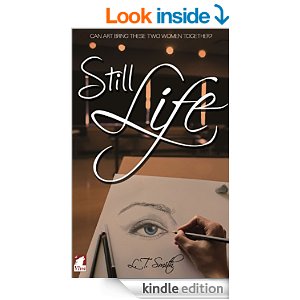
Seeing L.T. Smith's newest novel released sooner than expected, I couldn't hit one click on Amazon fast enough. As I have with her previous novels, I got a bit giddy with how hilarious and deep down good Still Life is, both in style (the language is a character all its own) and story (a complex roller coaster of a ride, always pulling you in.)

No one gets the wonders of emotion and "does she or does she not like me?" like L.T. Smith does. And the vulnerability of her main characters is very touching and a huge bonus. They can also be adorable without being precious and their self-doubt rings so true it can be absolutely heart-breaking.

You want to quietly scream at Jess (the center of Still Life): "You're an idiot; can't you see she likes you?" Then you remember what it's like to think (even know) that you could never be liked back by that special someone...and, of course, there's the simple fact it's fiction (where chances are much higher unrequited love will turn out to be very much requited) and the reader is able to step back and see things differently than the characters do.

Besides the sweetness of it all, there's the uncomfortably relatable, where you feel like L.T. Smith knows exactly how you feel and you know immediately she just gets it, gets that horrible and beautiful jumbled mess of liking someone a lot:


"I wanted to not feel the way I did, wanted to not like Diana Sullivan as much as I did. I really wanted to hate her, even just dislike her intensely, but it wouldn't come....I felt as if I should fill the void, but I couldn't drag anything from the depths to help me out. I was nervous, apprehensive, expectant, yet not. The silence seemed to drag and drag, and I was as useful as a chocolate teapot. I wanted to blurt out that I liked her--just so she'd know. No strings."

"No strings." That part is my favorite. If only you could tell someone how you really feel, just say it once (and quickly), then that would be it. No strings, not a single one, would be attached.

All in all, I thoroughly enjoyed Still Life, though I would have loved the opportunity to have a geeky bookworm type (coke bottle glasses and all) be the object of someone's love and lust. There's a rather comedic moment in the beginning of Still Life when Jess Taylor thinks the voice that enchants her from the other side of the room belongs to a woman who looks exactly like Professor Sybil Trelawney from the Harry Potter movies.

Because of my own hang-ups about how looks are portrayed in books, film and even pop music, I actually felt a flicker of hope that finally a character in a romance novel is non-traditionally attractive and might actually have physical character to her face. Not only does she turn out to not be the woman with the wonderful voice, Jess is relieved to discover the voice belongs to Diana Sullivan, whom she refers to as "gorgeous" several times throughout the book.

But Diana, thanks to a writer who always sees beneath the surface of things, turns out to be far more than a pretty face and the reader gets a funny and delightfully endearing love story full of see-sawing emotions that give it a painful and poignant rawness. L.T. Smith's characters have a philosophy of love (*see below) that makes one sigh extra hard, which is absolutely everything you could want until you have to return to reality after finishing the last page.


*"If I had to choose between the erotically charged encounter we had shared the previous evening and the one I was now experiencing curled up on the chest of the woman I was falling for, I would have been hard pushed. Cuddling was delicious intoxicating, but in the most ethereal way imaginable. I believed I had waited all my life to experience that feeling. I was home. This being together was home. She was home. My home."


Wednesday, September 3, 2014


Love is not a competition. Honestly, it's not. Even, when I started middle school and began realizing a little more as each year went on that I was as bad at pairing off as I was at being picked for teams in gym class, I didn't think of love (or the kids' version of it anyway) as something some people were better at than others. 

By high school I had begun to understand why it didn't bother me so much that boys didn't seek me out for dates. I even began to think of my non-popularity, my ability to both stand out as a geek and disappear into thin air as a non-datable, as the perfect cover.

No one would wonder why I didn't go out with boys because it was so perfectly obvious...the shy bookworm with big hair and out-of-fashion clothes would of course be home on Friday and Saturday nights reading her brains out while Chopin played on the stereo. Even my own parents wouldn't think to question why I wasn't interested in a social life. My sister had one big enough for the both of us.

As I grew older and college became so much more socially comfortable and likable than any previous levels of my education, there were different reasons for my not dating. I wanted to, for the first time in my life, but I had to pretend to myself I didn't.

Coming out where I went to college was most certainly not an option, especially not a safe one and most definitely not in the late 80s, and the only girl I really liked, a wildly eccentric and kind girl who had a thing for Gabriel Garcia Marquez, juggling and setting Walt Whitman to music, mostly just patted me on the head and called me "sweet." She would go on, as a straight woman, to champion gay causes years down the road, but at that time I had no clue if I would lose her friendship or not by confiding I had a crush on her.

I cherished our discussions after English class two days a week and then spent the rest of my time trying my best to like boys anyway. I met a guy who liked Roger Whittaker albums and bow ties. He was nice enough and I found his steps out of time charming, but my heart wasn't in it. When he started going out with my friend the next month, it didn't hurt at all. I went back to being the girl with the big hair and crazy clothes and read in my dorm all weekend long.

For all of my twenties I would try and make myself like the men who occasionally asked me out on dates. I did it to please my parents and to put forth one last ditch effort (again and again) to be as normal as possible. I wanted normalcy and my parents' love more than what my heart really wanted: a deep and meaningful relationship with someone kind and smart and passionate about books and music, who just happened to also be a girl.

Sometimes it feels like things come full circle...in my late 30s I couldn't stand faking my way through my personal life so I went to a singles group for gay women and when that didn't work tried the personals. It was like middle school again, only this time I did care I was un-datable and that things like "the third date rule" were deal-breakers and statements like "What do you mean you're old-fashioned? Lesbian can't be conservative and religious" abounded right and left. I would rather be alone than give in to some skewed dating 101 philosophy I didn't believe in.

Once again, minus the big hair and crazy clothes, I find myself home on weekend nights reading books and listening to music. And as before I don't really mind at all...because they might not be everyone's definition of love, but for me, right now at least, books and music are...because love isn't a competition, it's about finding what makes you happy, even if it isn't always a person. 

Monday, September 1, 2014

There are so many reasons I still think of The Love Boat fondly. The show might look extra silly when you watch it on MeTv or TVGuide Network these days, it might even look very dated, but it retains a goofy and refreshing sincerity you just don't see that much of on current television. And where else could you find guest stars as varied and super-appealing as Ethel Merman, Bobby Sherman and Debbie Allen?

I remember it for personal reasons as well as for pop cultural ones. ABC's Saturday night hit was most popular while I was in elementary school and early middle and I associate it with a very pleasant time before things got a bit rough. My parents did things socially and were much happier then and my sister and I got along and shared a kooky love for this over-the-top show.

Just a few hours ago, while I ate my lunch, I watched an episode I DVR-ed yesterday. Joan Rivers, of all people, guest starred as a breast cancer survivor who had recently undergone a mastectomy and a divorce at the same time.

Despite how odd a vehicle for such a serious topic (and despite the craziness of the other storylines within), this particular Love Boat treated its subject with genuine thoughtfulness and reality. And Joan Rivers (while not necessarily delivering an Emmy-worthy performance) also startled me a bit, playing a likable, even kind character.

I've only ever seen her mean side, the part of her that seems to thrive on picking apart other people, using them over and over again as comedic fodder. (She said some particularly cruel things right after Karen Carpenter passed away, which went way beyond thoughtless.)

Now, that she is in the hospital and in such serious condition, I find myself feeling sorry for her, though I still wonder how she could spend so much of her career being nasty to others.

The woman I saw in the Love Boat rerun seemed a different lady, entirely. I honestly believe there is good in pretty much everyone and I'd like to believe there's good in her too. I hope for her family's sake and hers she is able to wake up from her coma and completely recover.

Just in case you've ever wanted to know who guest starred on The Love Boat over the years here's a list:

http://www.imdb.com/list/ls003505129/

Monday readings...or the rest of Sunday's papers

I'm still reading the Sunday papers from yesterday and saw this article on text-bubble anxiety in the New York Times:

http://www.nytimes.com/2014/08/31/fashion/texting-anxiety-caused-by-little-bubbles.html


Catching up with the Guardian today, I read this:

http://www.theguardian.com/commentisfree/2014/aug/31/jennifer-aniston-childess-women-judged-unfairly

I find it interesting in a more general than personal sense since I've never been asked why I don't have children or why I'm not married (well, except by my mom!) but I imagine it's true to a lot of women's experiences.

I think that there are also women who wanted children very very much at one time in their lives, but made peace with not having them once it became clear motherhood just wasn't going to happen. Maybe biology played a part or they wanted to raise a family with someone else and never met that special person...

Some people (usually people who should just mind their own business)make assumptions that should only ever remain inside their own heads and never be spoken aloud. None of us ever really knows why someone else does or doesn't do something and it's not for us to judge them. I've always believed true feminism is having self-autonomy as a woman, whether you decide to have children or not.


The Remarkable Journey of Miss Tranby Quirke is the kind of book you need a few days to think about before you understand if you truly like it or not. I guess that sounds a bit bizarre or indecisive, but the truth is Elizabeth Ridley's period piece, while extremely well-written, deeply touching and downright beautiful at times, leaves me a bit uneasy.

Tranby and Lysette, surely two of the most unlikely women to ever fall in love with each other, are each so severely messed up emotionally (in their own unique ways) that I'm not sure either should be seeking any relationship, much less one with each other. They are both also wonderful and caring, but it is 1909, after all, and so much is already on their plate that time and circumstance threaten to crack it beyond repair.

Maybe I'm reading way too much into everything that happens, but I also question what is real and what is not and if our narrator Miss Tranby can even be trusted. Things are so wispy and fragile by the end, the reader cannot help but feel sad rather than hopeful. The Remarkable Journey of Miss Tranby Quirke is definitely a solid read...whether it's a solid romance is an entirely different matter.
 
There are some sweet passages within the novel that I just had to highlight in Kindle. The first section is a scene where Miss Tranby is bound and determined to deconstruct her feelings for Lysette and make them go away. As you can see, she's not doing too well with that:
 
If only you could see the sadness, the loneliness, the lies and the compromises…myself, and attempted to reduce to ordered terms this unsettling development.
 
DIAGNOSIS: Love. No. Not possible.
 
SYMPTOMS: Giddiness, shortness of breath. Urge to gather flowers. No. Lips that long to kiss. No. No. Tremors in hands and knees. Flightiness and his twin pain, optimism. General soreness in thorax. Rash on neck. No. Soft tissue breaks out in hives, in the pattern of the rose bush raising thorns. NO. My heart hurts. Poked and nibbled by plush, carnation-flavored lips. NO!
 
PROGNOSIS: Poor. ANTIDOTE: Lysette. A last desperate bid to live: Lysette. CURE: Unknown to man. Lysette McDonald. Yes. Only Lysette. Lysette Lysette Lysette.

The second is more of a general observation that most any gay woman would probably tell you is all too familiar. At this point, Miss Tranby is thinking of how nice it would be to have someone to talk to who knows exactly what she has gone thrown as an "invert" (a term often used well into the 20th century to describe gays and lesbians):
 
 
We would have spoken honestly about the beauty of women, and the wild emotions they sometimes engendered, and what it was like, as an invert, to feel so odd, so stricken by strangeness, and yet so deeply wonderful, both at the same time. She would have known and understood all those feelings, and neither one of us need have felt lonely.

 
This is a second cover for the novel...and much more in keeping with how Miss Tranby is described within its pages. The inner turmoil she experiences, though, is better captured in the gestures of the woman on the first cover. It kind of bugs me when a cover goes for a more "traditionally" attractive woman instead of how she actually looks. Sometimes you'll read a book only to discover the artist most likely either didn't bother to read it at all...or just didn't care.