
My friend gave me these recently and I find they really do help with anxiety.
More info here:
https://www.amazon.com/Against-Anxiety-Cards-Catchyourdreams-Affirmations/dp/B09XTNKRFF

Welcome to my little corner...All over the map with thoughts, I'm just here to blog about different things: life, music, stuffed animals, restaurants, shops, dreams, film, books, magazines, short stories, food, the sometimes silly, drink, feelings, love and tons more...
More info here:
https://www.amazon.com/Against-Anxiety-Cards-Catchyourdreams-Affirmations/dp/B09XTNKRFF


(An imagining)
In a small town where time seemed to move at its own pace, Lily and Emily unknowingly wove their lives together through the delicate threads of fate.
After high school, their paths diverged, yet the universe conspired to keep them in proximity, never allowing their orbits to intersect.
Through the years, Lily and Emily crisscrossed each other's existence like ghostly echoes. In bustling cafés, they sipped coffee at neighboring tables, blissfully unaware of the other's presence. The same park bench witnessed their solitary musings, separated by mere moments in time.
As decades unfolded, they shared the same neighborhood, passed each other in crowded markets, and attended events where their gazes grazed but never connected. Destiny's whims kept their lives parallel, but never overlapping.
In their twilight years, Lily and Emily found themselves in the embrace of a retirement home, their shared history unbeknownst to both.
Fragments of memories lingered, hinting at missed encounters and silent regrets.
One day, as the sun dipped low on the horizon, they sat together in the quiet courtyard.
Lily, with a fragile smile, turned to Emily. "I've carried a weight from high school, an unspoken sorrow. I'm sorry for what happened back then."
Emily's eyes softened with understanding, realizing the puzzle pieces falling into place.
With a bittersweet acknowledgment, she replied, "Lily, I forgave you long ago. Life led us on separate paths, but now we've found our way back."
In that poignant moment, the weight of the past lifted.
Though Lily's feelings remained unrequited, there was a profound sense of closure. As the sun set on their intertwined lives, they found peace, forgiving the echoes of their shared past.
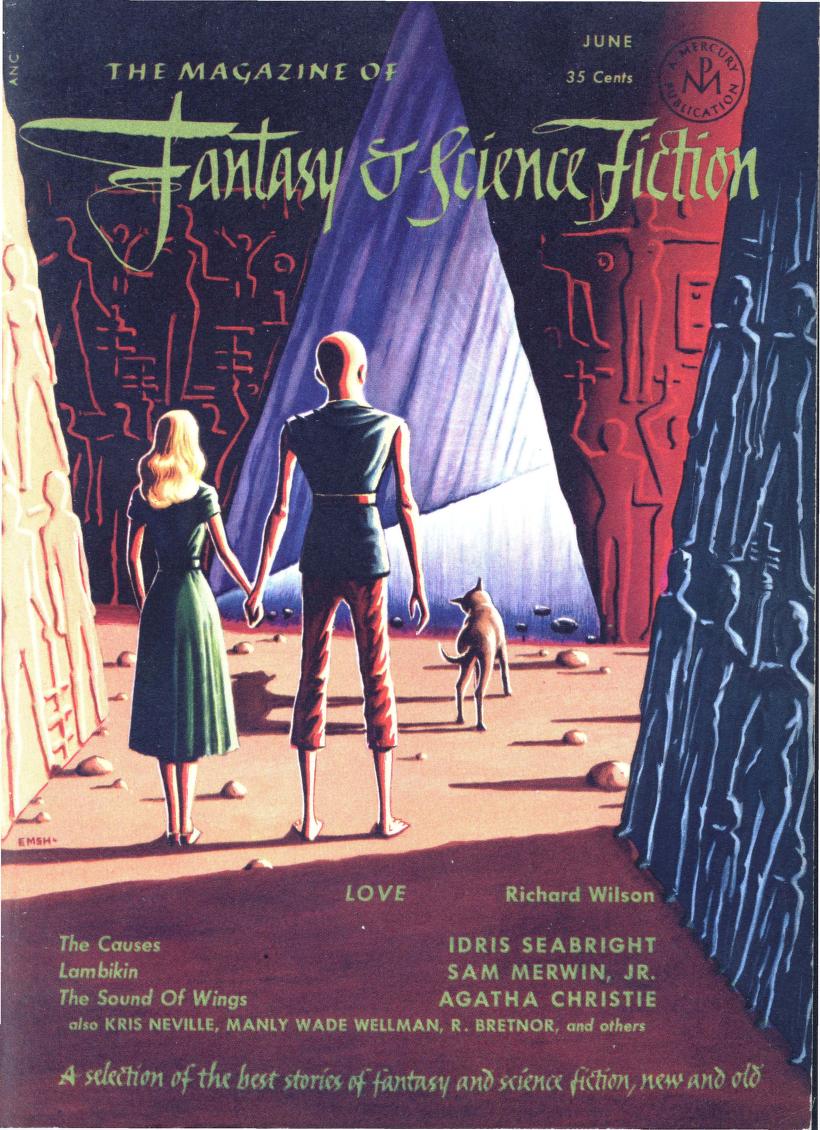

https://archive.org/details/Fantasy_Science_Fiction_v003n03_1952-06/page/n3/mode/2up
The Internet Archive is a treasure trove for anyone who loves vintage science fiction. You can find more Fantasy and Science Fiction issues here:
https://archive.org/details/fantasyandsciencefiction

I wish there were a way to find out more about Sloane Britain, an amazingly talented pulp fiction writer who died way too young and under way too sad circumstances (she killed herself when her family could not deal with her being gay, according to one source, though another states she died in a car accident.)
While some of what she wrote ended in unhappiness typical of lesbian fiction at the time, books like _These Curious Pleasures_ and _First Person 3rd Sex_ had something more upbeat to offer, either with actual happily ever afters or at least hints of something better to come.
There is so much to like about this book except maybe the title which doesn't exactly roll of the mouth easily. I found myself enjoying several of the passages...ones such as this:
"I felt like laughing because, well, let's admit it, if you're not feeling anything there is something absurd about normally self-controlled dignified human beings grunting and panting with that expression of complete absorption on their faces." Paula (our main character whose heart is bigger than her head and far less practical when it comes to her roommate Janet) contemplates how silly physical love can be without emotional ties.
There's another great line about the main character's history with crushes and, later, she wrestles with how hard it is to meet someone she could actually share a life with forever (something a lot of people search for whether they are gay or straight).
"All I was sure of," Paula thinks to herself, "was that someday, somewhere, I would find that woman who would love me as I loved her. I don't know her name or what she looks like or anything about her, only that as I write this she, too, is waiting."
(I wonder if this is how Sloane Brittain herself felt…)
To contemplate that this was written six decades ago, when most pulp fiction featuring gay women had them "changing their minds," killing themselves, or being committed to institutions...well, that just makes this impressionable book even more overwhelming.
Katherine V. Forrest, a somewhat more modern pioneer in lesbian fiction, once wrote about women like Sloane Britain: "The courage of the authors of these books also cannot be overstated, pseudonyms be damned. The writers of these books laid bare an intimate, hidden part of themselves and they did it under siege, in the dark depths of a more than metaphorical wartime, because there was desperate urgency inside them to reach out, to put words on the page for women like themselves to read. Their words reached us, they touched us in different and deeply personal ways, and they helped us all....In my case, they saved my life."
These words strike hard with the truth, especially for anyone who has ever suffered in silence for fear speaking out would cost them their family or worse.
"Especially Heinous: 272 Views of Law & Order SVU" is a novella written by Carmen Maria Machado in 2013. This weird tale unfolds through 272 capsule synopses, each encapsulating a distinct perspective from the initial 12 seasons of the police procedural series, Law & Order: Special Victims Unit. Originally featured in The American Reader in May 2013, the novella is also included in Machado's 2017 short story compilation, Her Body and Other Parties.
"Law and Order: SVU" is renowned for its unflinching portrayal of heinous crimes, particularly those of a sexual nature. The series focuses on the Special Victims Unit, a team of dedicated detectives who navigate the intricacies of sexual assault and abuse cases. The exploration of power dynamics and the abuse of authority is a central theme that echoes throughout the series.
Similarly, Carmen Maria Machado's Her Body and Other Parties dissects power imbalances in various forms. Through a series of surreal and haunting tales, Machado explores the ways in which power is wielded, misused, and resisted, often using the female body as a focal point for her narratives.
The stories challenge societal norms, inviting readers to reconsider their understanding of power and its implications. Despite the bizarre nature of "Especially Heinous" and how it deviates somewhat from the actual SVU, the story fits perfectly with the other stories.
In both the TV series and the short story collection, vulnerability takes center stage. "Law and Order: SVU" portrays the raw and often harrowing experiences of victims as they navigate the criminal justice system. The show humanizes survivors and highlights the strength required to overcome trauma.
Machado's Her Body and Other Parties similarly places vulnerability at its core. Her narratives delve into the emotional and physical vulnerabilities of characters, challenging traditional notions of strength and weakness. Machado's stories often blur the lines between reality and fantasy, creating a space where vulnerability is not a flaw but a powerful force in its own right.
While "Law and Order: SVU" primarily follows law enforcement officials in their pursuit of justice, Machado's stories offer a more nuanced exploration of the concept. Justice, in "Her Body and Other Stories," is not always served through traditional means. Machado prompts readers to question societal norms and consider alternative forms of justice that may involve personal growth, self-acceptance, and the reclamation of one's agency.
"Law and Order: SVU" and Her Body and Other Parties may exist in different realms of storytelling, but their thematic resonance is undeniable.
Both works challenge audiences to confront uncomfortable truths about power, vulnerability, and justice. Whether through the screen or the written word, these narratives serve as poignant reminders of the importance of empathy, understanding, and the ongoing pursuit of a more just and equitable society.
You can read the story here:
https://theamericanreader.com/especially-heinous-272-views-of-law-order-svu/

